
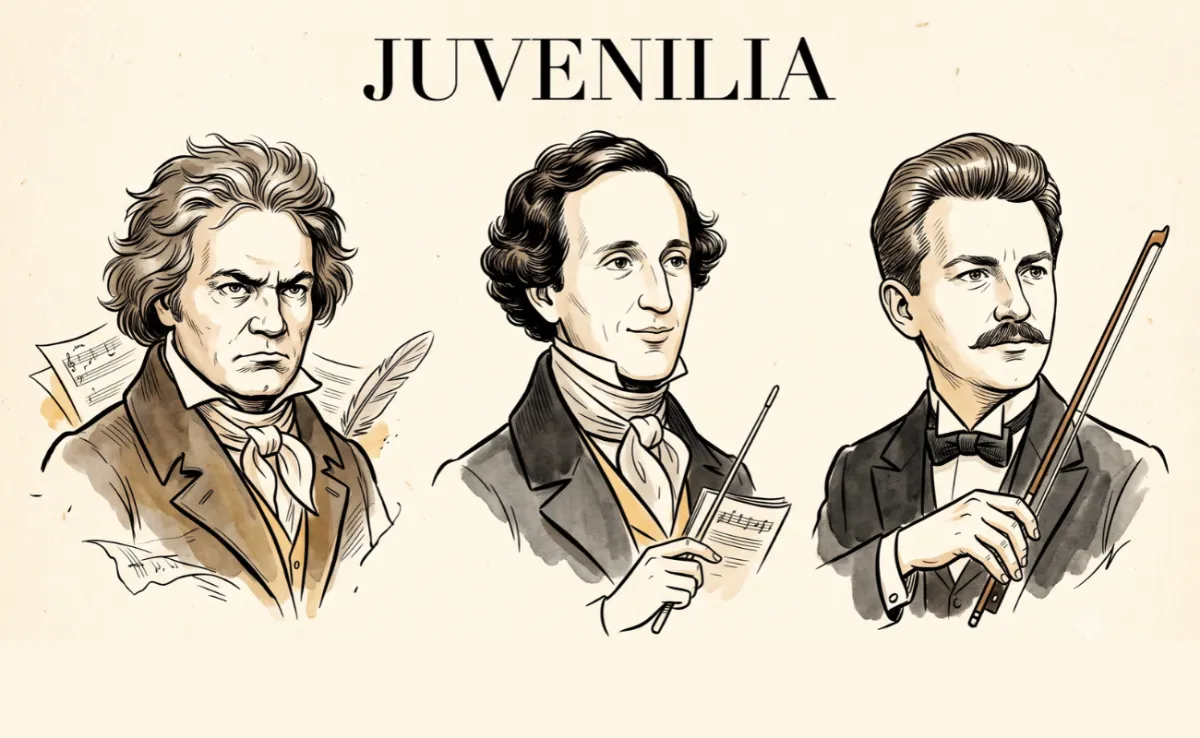
Quartetto Montale | Juvenilia
The proposal
At the origins of genius: youthful chamber-music masterpieces by great composers.
Of the great composers we know above all the masterpieces of their maturity.
Yet many of them began composing very early, leaving us youthful works that are rarely performed today and therefore almost unknown.
Juvenilia is a journey to rediscover these hidden gems.
Ludwig van Beethoven (1770–1827)
Quartet No. 1 in C major, WoO 36.
The programme opens with one of the three Piano Quartets written by Beethoven and completed in 1785 – the same year in which Mozart published his Quartet in G minor, K. 478, an absolute masterpiece of the genre.
Beethoven was barely fifteen. Curiously, the young Ludwig did not take his inspiration from the Salzburg composer’s quartet – whom he nonetheless admired and went on to study in Vienna – but drew his inflections and style from his Sonatas for Violin and Piano of 1781.
Despite his youth, the piece already reveals assured writing and an innate ability to invent memorable themes. Some of these themes were evidently so dear to the composer that they resurfaced years later in important piano sonatas: from Op. 2 Nos. 1 and 2 to Op. 13, up to Op. 27 No. 1. Anyone who knows Beethoven well will certainly recognise the theme of the Adagio con espressione, taken up and transformed in the Adagio of the Sonata Op. 2 No. 1. –
Felix Mendelssohn (1809–1847)
Quartet in F minor, Op. 2.
Mendelssohn embodied ideals of formal perfection and clarity that brought him close to Mozart, his ideal point of reference.
He grew up in a family frequented by the brightest minds of the age, and he and his sister Fanny — equally gifted but sadly much less celebrated today — were encouraged to compose for the musical evenings held at home.
The Quartet in F minor, Op. 2, written in 1823 when Felix was fourteen, is dedicated to Friedrich Zelter, his composition teacher since the age of eight. It was Zelter, a personal friend of Goethe, who arranged the celebrated first meeting in 1821 between the old poet – then seventy-two – and the twelve-year-old musician. Felix played for hours, performed pieces by great composers, presented compositions of his own and improvised. Goethe was so impressed that he wanted to see him again several times: a friendship was born that lasted until the poet’s death in 1832.
The Quartet Op. 2 is structured in four well-balanced movements, with an intermezzo in place of the scherzo. The minor key generates incisive, restless themes, while the musical discourse oscillates between tormented chromaticism and luminous major-key openings that would later become one of the most recognisable hallmarks of Mendelssohn’s style. –
Josef Suk (1874–1935)
Piano Quartet, Op. 1
A Czech composer of great stature, Suk is little known in Italy. Trained as a violinist and pianist, he studied composition with Dvořák – whose son-in-law he also became, having married his daughter Otilie.
For over forty years he was second violin of the Bohemian Quartet, founded in 1891 with several fellow students and soon established internationally.
In that very year, 1891, for his composition diploma, Suk wrote his Piano Quartet, Op. 1. Dvořák was so enthusiastic that he personally recommended its publication to the publisher Simrock. The piece unfolds in three intense movements, dense with vibrant Romanticism. The influence of the master is evident, but original traits already emerge: a free and personal use of harmony, broad themes of great expressive breadth. Suk’s language would go on to evolve over the following years, but this quartet represents an essential starting point – and a work that deserves to be heard again today.
Performers
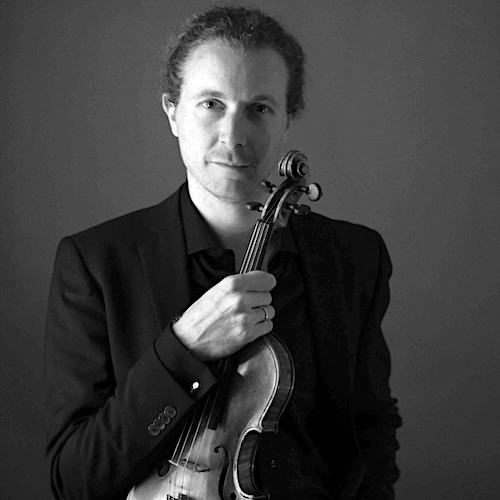
Elia Leon Mariani
MusicianViolinBorn in Milan, he trained at the Civica Scuola di Musica “Claudio Abbado” with Ruggero Fededegni and furthered his studies with Dejan Bogdanovich and Konstantin Bogino. Winner of national and international competitions as a duo…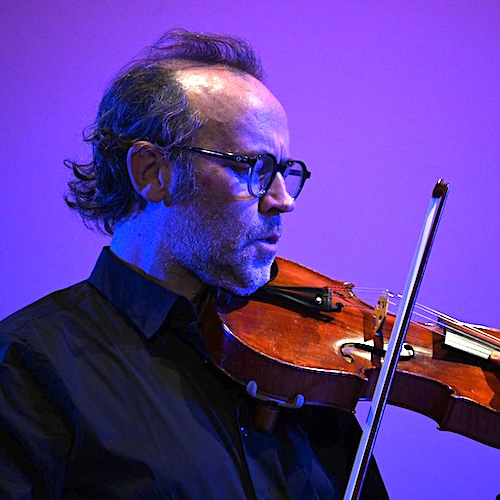
Giovanni Mirolli
MusicianViolaGiovanni Mirolli is an Italian violist and violinist active in both teaching and concert performance. He has collaborated with leading opera and symphony orchestras, including the Orchestra Sinfonica di Milano Giuseppe Verdi and…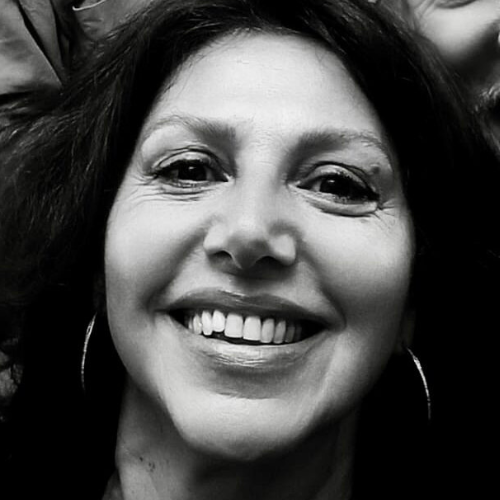
Francesca Ruffilli
MusicianCelloA Milanese cellist, she furthered her studies in Switzerland with Paul Szabo, cellist of the celebrated Végh Quartet, and from the very beginning has pursued an intense artistic career as a protagonist in both orchestral and…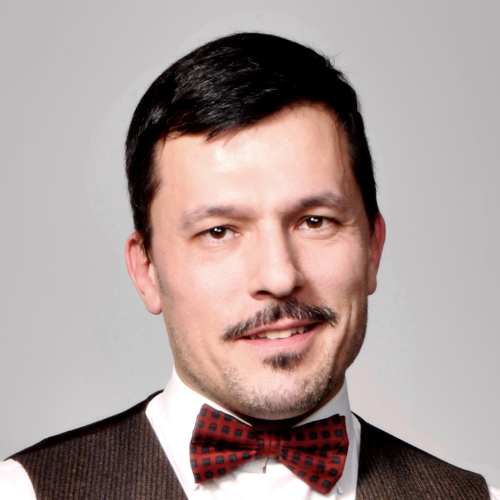
Christian Schmitz
MusicianPianoBorn in Milan, he graduated in piano from the Conservatoire of his home city under Maestro Sergio Lattes. He then furthered his studies with Maestro Boris Petrushansky, Prof. Nelly Ben-Or and Prof. Maria Luisa Franco, graduating…