
Lo strano caso di Agostina Meravigli, detta “La D’Artagnan”
The proposal
Rome, 1948: anatomy of a cold case between crime reporting and bourgeois prejudice
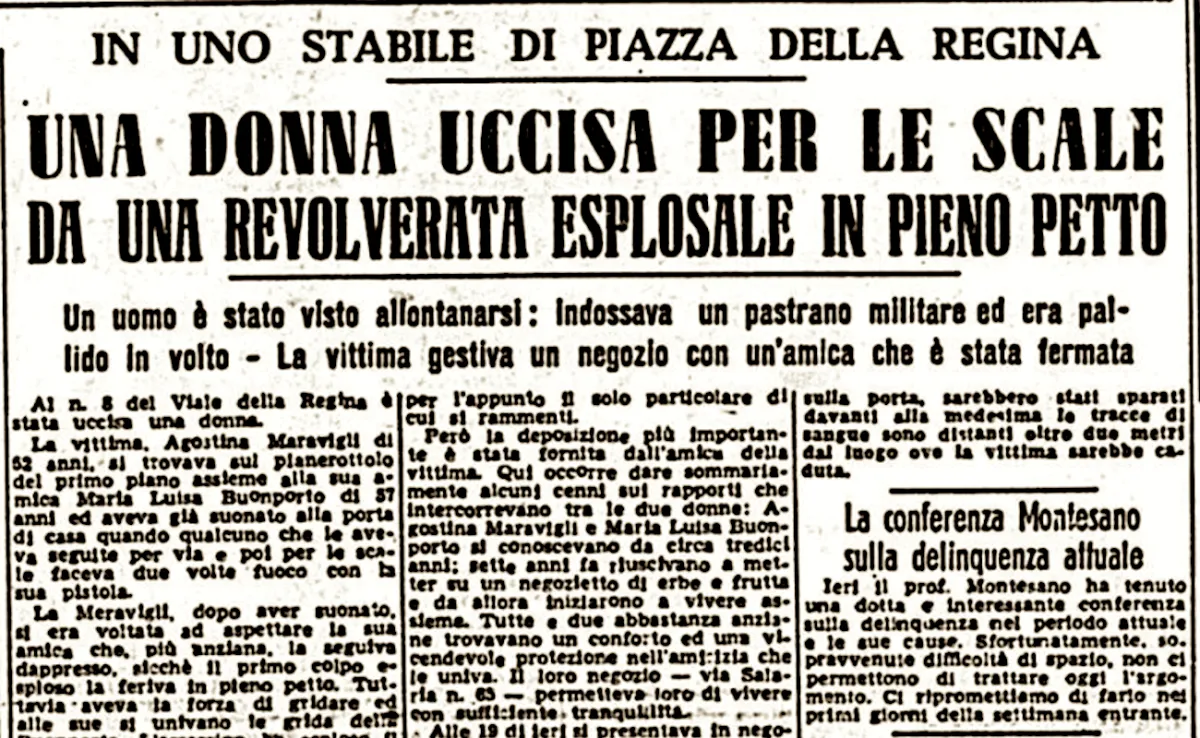
Rome, Saturday 7 February 1948. In a quiet, elegant building in the Salario-Nomentano district, a gunshot echoes through the dark entrance hall: Agostina Meravigli, a fifty-two-year-old greengrocer from Via Salaria, is killed on her doorstep.

The crime erupts into the capital’s crime reporting, but behind the initial theory of a robbery gone wrong, an uncomfortable truth for the public opinion of the time soon emerges. Agostina is a lesbian, wears men’s tailored clothes, keeps her hair cropped at the nape and is known to everyone as “D’Artagnan”.
Her modest herb and vegetable shop turns out to be a precious oasis of sociability and protection for Rome’s homosexual community in the immediate post-war years. The investigation is entrusted to the top officers of the Rome police headquarters, led by officials with a past compromised by the Fascist regime and deeply steeped in the moralism of the time.
The investigators immediately apply an exclusionary theory conditioned by prejudice: since this is the murder of an “abnormal” woman, the culprit must be sought solely in the squalid circle of vice and among its habitués.
Through relentless interrogations, reticence, anonymous letters from “mothers of families” and twists orchestrated by the trade press, the narrative pieces together the stages of a forgotten cold case. A story that goes beyond the boundaries of a bloody crime to become a raw portrait of a bourgeois, conformist and deeply hypocritical society.
The show takes the form of an investigative monologue in a true-crime key, in which the rhythm of civic theatrical storytelling is interwoven with meticulous archival reconstruction work. The narration gives voice to police reports, court documents and articles from the popular magazines of the day such as Crimen, bringing out the sharp contrast between the brutality of the facts, the discriminatory language of the media of the time and contemporary sensibility.
The project thus addresses both the suspense of the detective puzzle and a reflection on the stigma and persecution suffered by LGBTQIA+ people in post-war Italy.
The staging is conceived to be agile and essential, with a lean technical set-up based on the interaction between the actor, a minimal set and the projection of original documents and period images. This approach makes the show versatile and easy to fit into theatre seasons, cultural festivals, civic-storytelling series and events dedicated to historical memory.